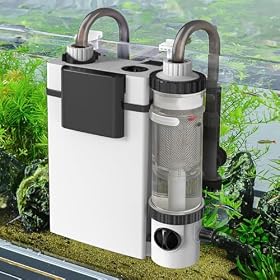
Turtles produce more waste than similarly sized fish, so choose a filter with ample biological and mechanical capacity—not just one whose label matches your tank’s gallons.
A good filter for a turtle tank should be rated for more water than the tank actually holds and have room for both mechanical and biological media. Turtles create a heavy waste load, so a filter sized only to the tank’s nominal volume may struggle to keep water clear and ammonia and nitrite under control. Filtration helps, but it does not replace regular water changes or testing.
How to size a turtle tank filter
Use the amount of water in the tank—not its advertised capacity—as your starting point. Substrate, décor, and a partly filled tank reduce the actual water volume.
Many turtle keepers choose a filter rated for a tank larger than theirs; a commonly used starting point is a rating around two to three times the tank’s actual volume. Treat that as a guideline, not a guarantee: filter ratings are not standardized, and the turtle’s size, feeding, and waste load matter. Check the manufacturer’s guidance and be prepared to monitor water quality after setup.
Pay attention to the filter’s stated flow rate as well as its tank-size rating. Flow can drop as media collects debris, and published flow may be measured under ideal conditions. Choose a model with enough capacity to maintain circulation without creating a current that makes it difficult for the turtle to swim, rest, or reach the basking area.
Choose a filter type
Canister filters
A canister filter is often a practical choice for a larger turtle tank or a high waste load. It sits outside the aquarium and typically offers more room for layered mechanical and biological media than a compact internal filter. Check that the intake and output can be positioned securely, that the unit is suitable for your tank setup, and that you can access it for cleaning.
Hang-on-back filters
A hang-on-back filter can suit a smaller setup if it has enough capacity for the turtle’s waste load and can operate at the tank’s water level. Check the required waterline and the manufacturer’s instructions; some designs may not work properly when the tank is filled below their minimum level. Secure the filter so it cannot be dislodged.
Internal filters
An internal filter can work in a smaller tank or as supplemental circulation, but compact models may have limited media capacity for a turtle. Check the rated tank size, media space, and flow direction. Keep the intake protected so the turtle cannot get trapped or injured, and make sure the filter is firmly attached.
Higher-capacity filtration for a larger turtle tank
Product prices and availability are accurate as of the date/time indicated and are subject to change. Any price and availability information displayed on Amazon.com at the time of purchase will apply to the purchase of this product.
Check these features before buying
Room for biological media: Beneficial bacteria live on filter media and help process fish and turtle waste. Look for a filter that provides a substantial, reusable media area.
Mechanical filtration: A sponge or other mechanical media catches visible debris. It should be easy to remove and rinse according to the manufacturer’s instructions.
Safe intake and manageable flow: Use an appropriate intake guard or prefilter sponge if needed, and position the output so the turtle has calmer areas to rest.
Compatible water level and setup: Confirm the filter works with your tank’s fill depth and can be installed as directed.
Easy maintenance: A filter that is difficult to reach or clean is less likely to be maintained consistently.
Product prices and availability are accurate as of the date/time indicated and are subject to change. Any price and availability information displayed on Amazon.com at the time of purchase will apply to the purchase of this product.
Set it up and keep water quality in check
Install the filter according to its instructions, secure the intake and output, and check for leaks or loose parts before leaving it running unattended. Use a drip loop on the power cord, and unplug electrical equipment before maintenance. Do not wash established biological media under untreated tap water or replace all of it at once unless the manufacturer’s directions call for it; preserving beneficial bacteria helps avoid disrupting biological filtration.
Test the water regularly, especially after introducing a turtle or changing filter media. If ammonia or nitrite is detectable, address the water quality promptly with appropriate water changes and check the filter and tank routine. A filter is not a substitute for removing waste and changing water. Follow care guidance for the turtle species, since appropriate water depth, current, and basking access vary.
Product prices and availability are accurate as of the date/time indicated and are subject to change. Any price and availability information displayed on Amazon.com at the time of purchase will apply to the purchase of this product.
FAQ
Can I use a fish tank filter for a turtle?
Yes, if it has enough capacity for the tank’s actual water volume and the turtle’s heavier waste load. Many keepers choose a filter rated for a larger tank than the one they have, then monitor water quality to confirm it is adequate.
Is a canister filter better for a turtle tank?
A canister filter is often a strong option for larger tanks because it generally offers more media capacity. A sufficiently capable hang-on-back or internal filter can also work in an appropriate setup.
Does a turtle tank filter eliminate water changes?
No. Filtration processes waste and catches debris, but routine water changes, waste removal, and water testing are still necessary.
How do I know if the filter flow is too strong?
Watch whether the turtle can swim, rest, and reach its basking area without struggling. Adjust the outlet or choose a filter with a more suitable flow if the current leaves no calmer area.