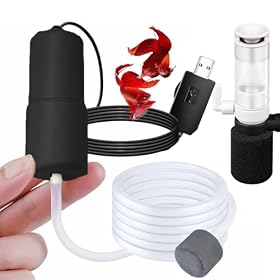
A battery backup air pump can keep oxygen moving when your aquarium’s main filter stops during a power outage. Here’s how to choose one based on tank size, fish load, runtime, noise, and automatic backup behavior.
Best battery backup air pump for a power outage
The best battery backup air pump for a power outage is one that starts automatically when household power fails, provides enough airflow for your aquarium, and runs long enough for the outage you are likely to experience. For most home aquariums, prioritize automatic changeover, dependable battery life, quiet operation, and a replaceable or readily available battery over maximum advertised airflow.
A backup air pump does not keep your filter’s impeller running. Instead, it powers an air stone or sponge filter to maintain gas exchange and, in some setups, biological filtration. That makes it a practical emergency device, but it should be sized and installed correctly.
What to look for in a battery backup air pump
Automatic power-failure switching
An automatic backup pump remains connected to a wall outlet and turns on when the outlet loses power. This is generally the most useful design for an aquarium because it does not depend on someone being home to activate it.
Check the product documentation for the exact changeover behavior. Some pumps may briefly pause before starting, while others may require the battery to be installed and charged before automatic backup works.
A manually switched battery pump can still be useful during short trips or planned outages, but it offers less protection against an unexpected failure.
Adequate airflow for the tank and air stone
Airflow is commonly listed in gallons per hour, liters per minute, or a similar unit. Do not compare the number alone. Airflow decreases when the pump must push water deeper, drive a restrictive air stone, or supply multiple outlets.
A pump should be able to run the air stone or sponge filter at the depth required by your aquarium. If the product documentation provides a maximum water depth or recommended aquarium size, use that information rather than assuming the highest airflow rating applies in every setup.
For a larger aquarium, a heavily stocked tank, or a tank with fish that are sensitive to low oxygen, consider a pump with more capacity or multiple outlets. You can regulate excessive airflow with an air valve, but a pump that cannot overcome water pressure will not provide useful aeration.
Runtime that matches the outage risk
Backup runtime depends on battery capacity, pump output, the number of outlets in use, water depth, and battery condition. Runtime claims should therefore be treated as estimates rather than guarantees.
Think about the outages common in your area:
- For occasional short interruptions, a basic automatic backup may be sufficient.
- For regular storms or overnight outages, look for longer documented runtime and a replaceable battery.
- For extended outages, a battery air pump may need to be combined with a larger backup power source, spare batteries, or a second aeration method.
If a product lists different runtimes, check what operating mode each figure represents. A low-output single-outlet setting may last much longer than a high-output or dual-outlet setting.
Replaceable batteries and charging behavior
Some aquarium backup pumps use replaceable household batteries, while others use an internal rechargeable battery. Each design has trade-offs.
Replaceable batteries are convenient during a prolonged outage because you can install fresh batteries without waiting for the unit to recharge. Rechargeable models may be easier for routine use, but their emergency runtime can decline as the battery ages.
For any design, verify whether the pump can remain plugged in continuously, whether it automatically maintains the battery, and whether it operates during charging. Follow the manufacturer’s charging and battery-replacement instructions.
Quiet operation
Noise matters if the aquarium is in a bedroom, office, or living area. Pumps can create a humming or vibrating sound even when the motor itself is relatively quiet.
Look for stable rubber feet, a low-vibration housing, and a way to mount or place the pump above the floor. Keep it on a solid, dry surface rather than hanging it from the aquarium rim. Do not place the pump where splashed water can reach the electrical connection.
One or two outlets
A single-outlet pump is often enough for a small aquarium or one air stone. A dual-outlet model can supply two air stones, two sponge filters, or separate aquariums, but it may use more battery power and may divide airflow between the outlets.
If you choose a dual-outlet design, check whether both outlets can be used at the same time during battery operation. Some products have different airflow or runtime specifications for backup mode.
Check valves and included accessories
A check valve helps prevent aquarium water from flowing backward through the airline if the pump stops or is positioned below the water level. If a check valve is not included, buy one sized for standard aquarium airline tubing.
You may also need airline tubing, an air stone, an air-control valve, or a sponge filter. These accessories affect back pressure and airflow, so avoid selecting a pump based only on the pump housing or battery compartment.
How to size the pump for your aquarium
Start with the aquarium’s water depth, fish load, and existing filtration—not just the tank’s gallon rating.
A lightly stocked tank with substantial surface movement may need less emergency aeration than a heavily stocked tank with warm water and limited circulation. Warm water holds less dissolved oxygen, and fish consume oxygen continuously during an outage.
For emergency use, place the air stone where it creates steady circulation without producing excessive turbulence. If you are powering a sponge filter, confirm that the pump can lift air through the sponge at the installed depth.
A backup air pump is especially useful for:
- Aquariums with high fish loads
- Breeding or hospital tanks
- Tanks using air-driven sponge filters
- Aquariums in areas with frequent storms
- Fish rooms with multiple tanks
- Systems where the main filter stops completely when power fails
Battery air pump versus a battery power station
A dedicated battery backup air pump is compact, simple, and usually focused on keeping air moving. It is often the easiest option for one or more small aquariums.
A portable power station can run a regular air pump, filter, or other aquarium equipment, but it adds more equipment and requires you to calculate watt-hours, AC losses, and the load of every connected device. It may be more suitable when you need to operate a filter, heater, or circulation pump—not just an air stone.
Do not assume that a small battery backup air pump can safely run a heater. Aquarium heaters draw substantially more power and require a backup system sized for their electrical load. Use only equipment rated for the intended connection, and follow the instructions for both the aquarium device and the backup power source.
How to set up and maintain the backup
- Install the battery correctly. Use the battery type specified by the manufacturer and observe polarity markings.
- Connect the airline. Attach tubing to an air stone or sponge filter, and add a check valve if the pump location requires one.
- Keep the pump dry and above splash level. Use a drip loop on the power cord so water cannot run toward the outlet.
- Test automatic operation. With the pump connected to the wall, unplug it from the outlet or switch off the relevant circuit only if you can do so safely. Confirm that backup mode starts and produces bubbles.
- Check it periodically. Verify the battery indicator, airflow, tubing, and air stone. Replace clogged air stones and hardened tubing.
- Keep spare supplies available. A spare battery, airline, check valve, or air stone can be more useful than a backup pump that cannot be connected quickly.
Do not test by disconnecting electrical equipment in a wet area. Keep hands dry, avoid overloaded outlets, and consult a qualified electrician if the aquarium circuit or outlet has a problem.
Common problems with battery backup air pumps
The pump does not start when power fails
Confirm that the battery is installed, charged, and compatible with the unit. Check that the main power cord is fully seated and that the outlet is actually powered. Some outlets controlled by a wall switch, timer, or ground-fault circuit interrupter may behave differently than expected.
If the pump has an indicator light, use the manufacturer’s instructions to interpret it. A failed battery or internal charging fault may require service or replacement rather than repeated resets.
The pump runs but produces weak bubbles
Inspect the air stone for mineral buildup and replace it if it is clogged. Check the airline for kinks, loose connections, or water trapped in the tubing. Make sure the pump is not being asked to push air through too many accessories or deeper water than specified.
If the pump works normally with open tubing but loses airflow through the air stone, the restriction is probably downstream of the pump. If airflow remains weak with a clear, short airline, the pump or battery may be failing.
Water is moving backward into the pump
Turn off or disconnect the pump safely, then inspect the airline routing. Install a check valve with its flow direction facing the aquarium if one is missing. Replace a damaged valve or cracked tubing. Keep the pump above the aquarium waterline when possible.
Water inside an electrical pump is a safety hazard. Do not continue operating a unit that has been flooded; follow the manufacturer’s disposal or service guidance.
The battery does not last as long as expected
Check whether the pump is running in a higher-output mode, supplying two outlets, or pushing air through a restrictive air stone. Older rechargeable batteries may hold less charge than when new. Cold storage conditions can also affect battery performance.
If runtime has declined substantially after normal charging and the battery is replaceable, replacement may be reasonable. If the battery is sealed and the unit no longer provides useful runtime, replacing the backup pump is often more practical than relying on it during an emergency.
Bottom line
Choose an automatic battery backup air pump with documented runtime, enough airflow for your aquarium depth, and a battery system you can maintain. For a single small tank, a quiet single-outlet model may be all you need. Larger or heavily stocked systems benefit from greater airflow capacity, multiple outlets, and a plan for extended outages.
A backup pump protects oxygen levels, not every aquarium function. Keep the water surface moving, avoid feeding during a prolonged outage unless necessary, and use a properly sized backup power solution if temperature control or filtration must also continue.