A hang-on-back (HOB) filter is usually the simplest all-purpose choice, a canister filter offers more media capacity and customization, and a sponge filter is the gentlest and easiest to maintain. The right option depends less on the filter label than on your tank’s size, fish load, water-flow needs, noise tolerance, and willingness to perform regular maintenance.
Choosing · Mon Sep 07
Hang-on-back versus canister versus sponge filter
Hang-on-back, canister, and sponge filters can all keep an aquarium clean, but they suit different tank sizes, bioloads, maintenance preferences, and noise tolerances.
Quick comparison
| Filter type | Best suited to | Main strengths | Main limitations |
|---|---|---|---|
| Hang-on-back | Many community aquariums and beginner setups | Easy installation, visible flow, convenient media access | Can be noisy if water evaporates or the intake draws air; may create stronger flow than some fish prefer |
| Canister | Larger, heavily stocked, planted, or specialized aquariums | Large media capacity, flexible media arrangement, quiet operation when properly installed | More involved cleaning, more tubing and seals, harder to service |
| Sponge | Fry, shrimp, quarantine tanks, and low-flow setups | Gentle flow, inexpensive operation, biological filtration, air-driven simplicity | Takes up space inside the tank and usually provides less mechanical polishing |
Protect small fish and shrimp from filter intakes
 AQUANEAT 6-Pack Pre-Filter Sponge for Aquarium Shrimp Fry Fish Tank Filter 0.8” Intake, Replacement Foam…AQUANEAT
$5.98 as of
View on Amazon- AQUANEAT 6-Pack Pre-Filter Sponge for Aquarium Shrimp Fry Fish Tank Filter 1” Intake, Replacement Foam…AQUANEAT
$14.85 as of
View on Amazon - AQUANEAT 6-Pack Pre-Filter Sponge for Aquarium Shrimp Fry Fish Tank Filter 0.6” Intake, Replacement Foam…AQUANEAT
$6.87 as of
View on Amazon
Product prices and availability are accurate as of the date/time indicated and are subject to change. Any price and availability information displayed on Amazon.com at the time of purchase will apply to the purchase of this product.
Hang-on-back filters
A HOB filter hangs on the rear rim of the aquarium. An intake tube pulls water into the filter, water passes through the filter media, and the cleaned water returns over the tank’s rim.
Choose a HOB filter when
- You want straightforward installation and maintenance.
- You need mechanical filtration that is easy to inspect and replace or rinse.
- You prefer keeping most equipment outside the aquarium.
- Your fish can tolerate the filter’s return flow, or the flow can be adjusted or diffused.
- You want a practical general-purpose filter for a community tank.
HOB filters are often a good starting point because media access is quick. Their rated capacity should not be treated as a guarantee, however. A heavily stocked tank, messy fish, or frequent feeding can require more filtration capacity or more frequent maintenance than the label suggests.
HOB issues to consider
Water evaporation can lower the aquarium level until the return becomes noisy or the intake begins drawing air. Some HOB filters also transfer vibration to the tank or cabinet. A prefilter sponge on the intake can protect small fish and shrimp while adding surface area for beneficial bacteria, but it must be rinsed when it becomes clogged.
Add gentle biological filtration or a backup filter
 ALEGI Aquarium Sponge Filter Pad, Bio Filter Media Foam SpongesALEGI
$8.99 as of
View on Amazon hygger Sponge Filter, Aquarium Filter Double Sponge Replaceable Media with 4 Biochemical Sponges and 1…hygger
$19.99 as of
View on Amazon- AQUANEAT 6-Pack Pre-Filter Sponge for Aquarium Shrimp Fry Fish Tank Filter 0.8” Intake, Replacement Foam…AQUANEAT
$5.98 as of
View on Amazon
Product prices and availability are accurate as of the date/time indicated and are subject to change. Any price and availability information displayed on Amazon.com at the time of purchase will apply to the purchase of this product.
Canister filters
A canister filter sits outside the aquarium and circulates water through intake and return hoses. Its sealed body can hold several types of media, such as coarse mechanical media, finer polishing media, and biological media.
Choose a canister filter when
- Your tank needs substantial media capacity.
- You want to arrange different filtration stages yourself.
- You are running a larger or heavily stocked aquarium.
- You want equipment hidden in the cabinet beneath the tank.
- You can commit to careful hose, seal, and impeller maintenance.
The main advantage is flexibility. You can use coarse media to catch debris before finer media, then reserve space for biological media. This can reduce how often biological media needs to be disturbed, provided the mechanical stages are cleaned regularly.
Canister issues to consider
Canister filters require more attention to installation. The hoses must be routed correctly, the lid gasket must remain clean and properly seated, and the unit must be primed according to its instructions. A small seal problem can cause air entry, reduced flow, or a leak.
Service is also less convenient than opening a HOB filter. Before buying a canister, make sure you have enough clearance to remove the lid and enough room to route the hoses without sharp bends. Never place an external filter where a possible leak could reach an electrical outlet or power strip.
Power a sponge filter or improve aeration
 Pawfly Aquarium 15-40 GPH Compact Air Pump Quiet Oxygen Aerator Pump with Air Stone/Nano Bio…Pawfly
$9.99 as of
View on Amazon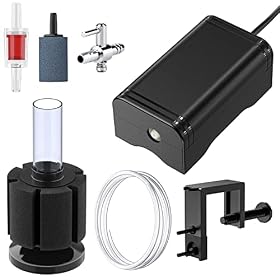 Pawfly Mini Aquarium Air Pump 15 GPH Quiet Oxygen Aerator Pump with Bracket Airline Tubing…Pawfly
$15.99 as of
View on Amazon HITOP Dual Outlet Aquarium Electric Air Pump, Whisper Adjustable Fish Tank Aerator, Quiet Oxygen Pump…HITOP
$14.97 as of
View on Amazon
Product prices and availability are accurate as of the date/time indicated and are subject to change. Any price and availability information displayed on Amazon.com at the time of purchase will apply to the purchase of this product.
Sponge filters
A sponge filter uses an air pump, airline tubing, and an uplift tube to draw aquarium water through porous sponge material. The sponge provides mechanical capture and a large surface for beneficial bacteria.
Choose a sponge filter when
- You are raising fry or keeping shrimp and need gentle flow.
- You are setting up a quarantine or hospital tank.
- You want a simple filter with few moving parts.
- You need biological filtration that can be powered by an air pump.
- You are willing to keep the sponge visible inside the aquarium.
Sponge filters are particularly useful where strong intake suction or high return flow could harm small or delicate animals. They also make useful backup filters or temporary filters during tank transfers.
Sponge filter issues to consider
A sponge filter does not usually make the water look as polished as a HOB or canister equipped with fine mechanical media. It also occupies interior space and depends on an air pump, check valve, and airline tubing. The pump may be the loudest part of the system, especially if it vibrates against a hard surface.
Clean the sponge by gently squeezing it in removed aquarium water, not untreated tap water. This helps preserve the beneficial bacteria living in the sponge. Follow the filter and aquarium manufacturer’s instructions if they specify a different service method.
Replace or expand filter media
 Fluval Pre-Filter Media, Mechanical Filter Media for Aquariums, 26.45 OZFluval
$14.99 as of
View on Amazon Sukh Ceramic Rings for Aquarium Filter - 15oz Bio Filter Media with 3 BagsSukh
$6.89 as of
View on Amazon- ALEGI Aquarium Sponge Filter Pad, Bio Filter Media Foam SpongesALEGI
$8.99 as of
View on Amazon
Product prices and availability are accurate as of the date/time indicated and are subject to change. Any price and availability information displayed on Amazon.com at the time of purchase will apply to the purchase of this product.
Which filter is quietest?
Noise depends on the specific design, water level, air pump, cabinet, impeller, and maintenance condition. In general:
- A well-installed canister filter can be quiet because the motor and water flow are outside and enclosed, but air in the system or a worn impeller can create noise.
- A HOB filter can be quiet when it is level, full of water, and operating at the correct tank level. Water falling too far from the return lip is a common source of noise.
- A sponge filter may be mechanically simple, but its air pump can hum or vibrate. A soft pad beneath the pump and a check valve installed in the correct direction may help.
If low noise is a priority, inspect the entire system rather than judging the filter type alone. Vibration, loose tubing, trapped air, and low water level can make an otherwise suitable filter seem loud.
Which filter provides the best filtration?
There is no universal winner. Filtration quality depends on adequate flow, enough media, correct setup, and consistent maintenance.
Mechanical filtration
Mechanical media catches particles such as uneaten food and waste. HOB and canister filters usually offer more room for layered mechanical media. Sponge filters provide mechanical filtration too, but the water may not become as visually clear if the sponge is coarse or undersized.
Biological filtration
All three types can support beneficial bacteria. The important factors are usable media surface area, steady water movement, oxygen availability, and avoiding aggressive cleaning that removes established bacteria.
Chemical filtration
Chemical media, such as activated carbon, is optional in many routine setups and is not a substitute for water changes or correcting the source of a water-quality problem. HOB and canister filters generally make it easier to add chemical media. Sponge filters can be paired with a separate media bag or another filter if chemical filtration is needed.
Match the filter to the tank
Consider these questions before choosing:
- How large is the aquarium? Use the manufacturer’s aquarium-size guidance as a starting point, then account for stocking and maintenance habits.
- How heavily stocked is it? More fish and larger fish generally produce more waste and may require greater media capacity or more frequent cleaning.
- Do the inhabitants prefer gentle flow? Bettas, fry, shrimp, and some delicate species may need a sponge filter, a prefilter, a spray bar, or a flow baffle.
- How much room is available? A HOB needs rear clearance, a canister needs cabinet and hose space, and a sponge filter uses space inside the tank.
- How often will you service it? Pick the design you can maintain consistently. A theoretically powerful filter is not useful if it is difficult to clean correctly.
- What happens during a power outage? Any filter stops circulating when power is lost. A sponge filter connected to a battery-capable air pump can be useful for emergency aeration, but prepare according to the needs of the livestock.
Can you combine filter types?
Yes. Combining filters can add redundancy and let each filter perform a different role. For example, a HOB can provide convenient mechanical filtration while a sponge filter supplies gentle biological filtration and protects small animals from a strong intake.
A canister and sponge filter can also work together when you want high media capacity plus a backup biological filter. Make sure the combined flow is appropriate for the livestock, and do not assume that adding equipment eliminates the need for water testing, water changes, or filter maintenance.
Practical choice guide
- Choose a HOB for a convenient, general-purpose filter with easy access to media.
- Choose a canister when you need more media capacity, hidden equipment, or flexible filtration stages and are comfortable with more involved service.
- Choose a sponge filter for fry, shrimp, quarantine tanks, low-flow environments, or simple biological filtration.
- Combine a HOB or canister with a sponge when you want backup filtration or gentler intake protection.
Whichever type you choose, size it using the manufacturer’s guidance, consider the actual bioload rather than tank volume alone, and keep a regular maintenance schedule. If flow suddenly drops, check clogged media, the intake, tubing, impeller, water level, and seals before assuming the filter motor has failed.
FAQ
Is a canister filter better than a hang-on-back filter?
Not in every aquarium. A canister usually offers more media capacity and flexible filtration, while a HOB is easier to install and service. Choose based on tank bioload, available space, desired flow, noise tolerance, and maintenance preference.
Are sponge filters enough for an aquarium?
A properly sized sponge filter can be enough for many lightly to moderately stocked aquariums, quarantine tanks, fry tanks, and shrimp tanks. Heavily stocked or larger aquariums may benefit from additional filtration capacity and more frequent maintenance.
Which filter is best for shrimp and fry?
A sponge filter is often the safest starting point because it provides gentle flow and avoids exposing small animals to a strong intake. A prefilter sponge can also make a HOB or canister intake safer, provided it is cleaned regularly.
Do canister filters need an air stone?
Not necessarily. A properly circulating filter can provide gas exchange at the water surface. An air stone may be useful when surface agitation is low or additional aeration is needed, but excessive flow can stress some fish.
How often should aquarium filter media be cleaned?
Clean media when flow decreases or debris has accumulated, following the filter manufacturer’s instructions. Rinse biological media gently in removed aquarium water rather than untreated tap water, and avoid replacing all established media at once unless the manufacturer or a qualified aquarium professional advises it.