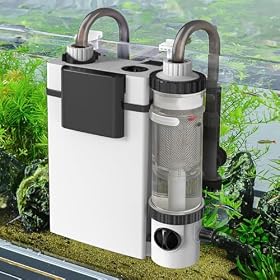
A sump gives a FOWLR tank more equipment space, water volume, and expansion potential, while a hang-on-back filter is simpler, cheaper, and easier to install. The better choice depends on tank size, fish load, overflow planning, and how much maintenance you want.
A marine sump is usually the better long-term choice for a larger or heavily stocked FOWLR tank, while a hang-on-back (HOB) filter is often the more practical choice for a smaller, lightly stocked, or non-drilled aquarium. A sump provides room for mechanical and biological media, a protein skimmer, heaters, and other equipment below the display. A HOB filter costs less, installs quickly, and avoids overflow and plumbing concerns.
What changes between the two setups?
A FOWLR tank—fish only with live rock—still needs dependable mechanical filtration and biological filtration. Live rock can provide biological surface area, but it does not remove all suspended waste, dissolved organics, or excess nutrients by itself.
The main difference is where the filtration equipment sits:
A HOB filter hangs on the back of the aquarium and draws water from the display, passes it through filter media, and returns it over the rim.
A sump is a separate container below the aquarium. Water drains from the display through an overflow, passes through one or more chambers, and returns through a pump.
Both can support a FOWLR system when sized and maintained for the tank’s actual fish load—not just the aquarium’s nominal gallon capacity.
Marine sump: advantages and drawbacks
Advantages of a sump
More room for filtration and equipment: A sump can hold filter socks or other mechanical media, biological media, heaters, probes, and a protein skimmer without filling the display with equipment. This is especially useful when keeping larger fish that produce substantial waste.
Greater total water volume: Water in the sump adds to the system’s total volume. More water can make changes in temperature and salinity less abrupt, although it does not eliminate the need for regular water changes or careful top-off.
Better concealment: The display can look cleaner because most equipment is located in the cabinet below the tank.
More expansion potential: A sump makes it easier to add equipment later, such as a larger skimmer, additional biological media, or a refugium section if your maintenance plan calls for one.
Flexible mechanical filtration: You can choose where and how to trap debris. For a FOWLR tank, this can help remove uneaten food and fish waste before it breaks down into additional nutrients.
Drawbacks of a sump
More installation complexity: A drilled aquarium needs an overflow and return plumbing. A non-drilled aquarium may require an external overflow box, which adds another component that must be installed and monitored.
Overflow and flood planning are essential: During a power outage, water can continue draining until the display’s water level reaches the overflow’s safe limit. The sump must have enough empty capacity to hold this drain-down water. The return line should also be positioned to limit back-siphoning, following the aquarium and plumbing manufacturers’ instructions.
Evaporation occurs in the sump: As water evaporates, the water level usually falls in the return-pump chamber. Salt does not evaporate, so topping off with fresh water—not saltwater—is normally required to maintain salinity. An automatic top-off system can make this easier, but it adds another device to maintain.
More points of failure: The return pump, overflow, plumbing joints, valves, and electrical connections all need attention. Use drip loops, keep electrical equipment protected from splashes, and follow applicable electrical safety guidance. If you are unsure about wiring or installing equipment near water, consult a qualified professional.
Product prices and availability are accurate as of the date/time indicated and are subject to change. Any price and availability information displayed on Amazon.com at the time of purchase will apply to the purchase of this product.
Hang-on-back filter: advantages and drawbacks
Advantages of a HOB filter
Simple installation: A HOB filter normally needs only a suitable tank rim, a properly seated intake, and a nearby electrical outlet. It does not require drilling or a cabinet full of plumbing.
Lower setup complexity: There is no separate sump to size, no return-pump chamber to monitor, and no overflow box to adjust. This makes a HOB appealing for a first marine aquarium or a temporary setup.
Easy access to filter media: Mechanical cartridges, sponges, or loose media can usually be removed and serviced quickly. You can also select replacement media compatible with saltwater, provided the filter manufacturer allows that use.
Useful for smaller FOWLR tanks: A HOB can work well when the fish load is modest, feeding is controlled, and maintenance is consistent. It is also a sensible option when the aquarium cannot support a drilled overflow or external plumbing.
Drawbacks of a HOB filter
Limited media capacity: The filter box is smaller than a sump, so there is less room for layered mechanical media, biological media, and other equipment. The limit becomes more noticeable as fish get larger or the bioload increases.
Less equipment space: Heaters, probes, and skimmers remain in or around the display unless you use separate equipment.
Potential for noise and salt creep: Water returning over the rim can create splashing. Saltwater spray may leave salt deposits on the filter and nearby surfaces, so wipe away salt creep and check the intake and return regularly.
Restart and clog concerns: A clogged intake, dirty impeller, or accumulated debris can reduce flow. Some HOB filters may not restart reliably after a power interruption unless they are cleaned, correctly seated, and designed to restart in that condition. Follow the manufacturer’s instructions rather than assuming the filter will recover automatically.
Less protection against changing water level: A HOB relies on a suitable display-water level. Excessive evaporation can make the return noisier or affect operation, depending on the design.
Product prices and availability are accurate as of the date/time indicated and are subject to change. Any price and availability information displayed on Amazon.com at the time of purchase will apply to the purchase of this product.
Direct comparison for a FOWLR tank
Consideration
Marine sump
Hang-on-back filter
Installation
Requires plumbing and overflow planning
Usually quick to install
Equipment capacity
High
Limited by the filter box
Display appearance
Most equipment can be hidden
Filter remains visible on the tank
Total system volume
Increases with sump volume
Adds little or no separate water volume
Power-outage planning
Must account for drain-down and back-siphon water
Usually simpler, but restart behavior still matters
Maintenance access
Easy access below the tank, but more components
Simple access to the filter and media
Noise
Can be quiet when correctly designed, but overflow and pump noise are possible
Usually straightforward, but splashing and vibration can occur
Expansion
Strong option for future equipment
Limited without adding separate equipment
Best fit
Larger, heavily stocked, or equipment-heavy FOWLR systems
Product prices and availability are accurate as of the date/time indicated and are subject to change. Any price and availability information displayed on Amazon.com at the time of purchase will apply to the purchase of this product.
Which is better for your FOWLR tank?
Choose a sump when:
The tank is large or will contain several sizable fish.
You want to use a protein skimmer or other equipment without crowding the display.
You want room to expand the filtration system later.
You are comfortable planning overflow capacity and power-outage behavior.
The aquarium is already drilled or is designed for a properly installed overflow.
Hiding equipment and increasing total system volume are important priorities.
A sump is not automatically more effective simply because it is larger. Poorly planned plumbing, inadequate mechanical filtration, an undersized return pump, or failure to account for evaporation can make a sump frustrating. The overflow, sump capacity, return pump, and drain-down volume need to work together.
Choose a HOB when:
The aquarium is small or moderately stocked.
You want to avoid drilling, plumbing, and overflow boxes.
You need a lower-complexity setup.
You are comfortable keeping the fish load within the filter’s practical capacity.
You can perform frequent mechanical-media cleaning and regular water changes.
The tank’s rim and rear clearance are compatible with the filter.
A HOB is not a reason to ignore stocking limits. A filter’s advertised flow rate does not by itself determine how much waste the aquarium can process. Media condition, actual flow after loading, live-rock capacity, feeding, fish size, and maintenance all matter.
Product prices and availability are accurate as of the date/time indicated and are subject to change. Any price and availability information displayed on Amazon.com at the time of purchase will apply to the purchase of this product.
How to size and operate either setup
Match filtration to bioload, not just tank size
Two aquariums with the same water volume can require very different filtration. A lightly stocked tank with small fish produces less waste than a tank containing large, messy-feeding fish. Plan around the adult size, feeding habits, and waste production of the fish.
Avoid using flow as the only measure of filtration. Strong circulation can help keep particles suspended and improve oxygen exchange, but it does not replace biological filtration or removal of trapped debris.
Use mechanical media deliberately
Mechanical media should capture particles without becoming a neglected nutrient trap. Inspect it frequently, especially after heavy feeding or tank maintenance. Replace or rinse it according to the media type and manufacturer’s guidance. When preserving beneficial biological bacteria is important, avoid cleaning all biological media at once in untreated tap water.
Keep the intake and return clear
On a HOB, inspect the intake screen, impeller, media basket, and return channel. On a sump, inspect the overflow teeth or screens, drain path, return pump intake, and return nozzle. A partial blockage can reduce circulation and may increase noise.
Check salinity as water evaporates
Top off evaporation with freshwater, not saltwater, unless you are deliberately correcting a measured salinity problem. In a sump system, watch the return-pump chamber because that is commonly where the water level changes most noticeably. In either setup, use a reliable salinity-measuring method and make changes gradually.
Noise and power-outage considerations
For a quieter system, look first for vibration, splashing, air entering the intake, restricted flow, and salt buildup. A HOB may become noisy when its water level is low or its impeller is dirty. A sump may become noisy if the overflow is not adjusted correctly, the return pump is drawing air, or the plumbing transmits vibration to the cabinet.
Before relying on a sump, simulate a power outage while supervising the system. Confirm that:
The display does not drain below the overflow’s intended operating level.
The sump can hold water from the display and return plumbing.
The return pump does not run dry when power returns.
The return line does not siphon more water than the sump can hold.
The system restarts as intended.
If you cannot confidently verify those points, do not operate the sump unattended until the design is corrected. Follow the aquarium, overflow, sump, and pump instructions.
Bottom line
For a simple, smaller FOWLR aquarium, a properly maintained HOB filter is often the easier and more economical choice. For a larger, more heavily stocked, or equipment-heavy system, a marine sump offers better capacity, cleaner equipment placement, and more room to expand—but it requires careful overflow, plumbing, evaporation, and power-outage planning.
Choose the sump for capacity and flexibility, not because it removes the need for maintenance. Choose the HOB for simplicity, not as permission to exceed a reasonable fish load.
FAQ
Can a HOB filter work on a saltwater FOWLR tank?
Yes. A HOB can support a FOWLR tank when its saltwater compatibility, media capacity, actual flow, and maintenance needs match the fish load. Keep the intake clear and clean mechanical media regularly.
Is a sump necessary for a FOWLR aquarium?
No. A sump is useful but not mandatory. A HOB filter can be suitable for a smaller or lightly stocked FOWLR tank, while a sump becomes more attractive as equipment needs, fish size, or bioload increase.
Does a sump make a marine aquarium easier to maintain?
It can make equipment access and water treatment more convenient, but it also adds plumbing, an overflow, a return pump, and power-outage planning. The maintenance may be easier in some areas and more involved in others.
Which is quieter, a sump or a HOB filter?
Either can be quiet when correctly installed and maintained. HOB noise commonly comes from splashing, vibration, air in the intake, or a dirty impeller. Sump noise can come from the overflow, return pump, plumbing vibration, or poor water-level adjustment.
What happens to a sump during a power outage?
The return pump stops, but water may continue draining from the display and return plumbing. The sump must have enough free capacity for this water, and the return line must be arranged to limit back-siphoning. Test this under supervision before leaving the system unattended.